What the Building Collapse in Gebze Tells Us:Making Hidden Risks Visible with Structural Health Monitoring (SHM)
On 29 October 2025, the sudden collapse of a seven–storey residential building in the Gebze district of Kocaeli, Türkiye, shocked the country. Within seconds, one ordinary apartment block turned into a fatal disaster. A family of five was trapped; tragically, only their 18-year-old daughter was rescued alive from the rubble.AA Agency
This event is a painful reminder that buildings can pose critical risks not only during earthquakes but also in everyday life, even on seemingly “quiet” days.
Subsequent investigations in the surrounding area revealed that many nearby buildings also showed serious structural problems. This is no longer about a single building; it points to a wider, systemic issue in the building stock.
As StructHealth, in this article we explore what we can learn from such incidents and where Structural Health Monitoring (SHM) fits into this bigger picture.
1. Why do “healthy-looking” buildings collapse?
Preliminary assessments and expert comments about the Gebze collapse highlight risk factors that are unfortunately familiar in many regions of Türkiye and beyond.
Ground movements and soil settlements
- Buildings founded on variable soil conditions may experience differential settlements over time.
- Nearby infrastructure works – such as deep excavations, tunnels, metro lines, or changes in the groundwater level – can weaken the soil supporting the structure.
- These settlements can create progressive damage, especially in corner columns and critical load-bearing elements, where stress concentrations and shear forces increase slowly but steadily.
Soft-storey effects and commercial use at ground level
- Ground floors used as shops, markets, cafés or restaurants often have fewer partition walls and larger open spans.
- This can create a soft-storey mechanism: the ground floor becomes significantly weaker and more flexible than the floors above.
- In both earthquakes and settlement scenarios, this soft storey tends to behave like the weakest link in the chain, making the entire building more vulnerable to collapse.
Historical use and thermal effects
- In some buildings, the ground floor may previously have been used as a restaurant or similar high-temperature environment.
- Prolonged exposure to heat can degrade concrete microstructure, reduce the bond between reinforcement and concrete, and weaken critical columns and beams.
- Even if visual signs are limited, the structural capacity may already be compromised.
Ageing, poor maintenance and ignored warning signs
- Cracks, excessive deflections, spalling at beam-column joints, as well as doors and windows that begin to jam, are often normalised as “old building behaviour”.
- In reality, these are key indicators that should be monitored throughout the service life of the structure.
- When such symptoms are ignored, damage can accumulate over years until a relatively small trigger leads to a disproportionate collapse.
Bottom line: Even if a building has an approved design, permit and occupancy certificate, if we are not monitoring soil conditions, usage changes and long-term behaviour, we do not have up-to-date information about its real safety.
For a more detailed overview of soil–structure interaction and how it affects building performance, see the technical guidance published by NIST.
2. Where does Structural Health Monitoring (SHM) come in?
Structural Health Monitoring (SHM) is the practice of measuring how a structure actually behaves in real life using sensors and data analytics – either continuously or at regular intervals – in order to detect damage and performance loss as early as possible. Structural Health Monitoring has evolved significantly over the last two decades, with a large body of research demonstrating its effectiveness for bridges, high-rise buildings and other critical infrastructure.
SHM is particularly critical for structures exposed to:
- Soil settlements and tilting (e.g. retaining walls, high-rise buildings, industrial facilities, structures next to deep excavations or tunnels),
- Soft-storey configurations with commercial usage at ground level,
- Older buildings that have previously experienced earthquakes or heavy loading,
- Seismically isolated buildings and special engineering structures,
- Schools, hospitals and other buildings where failure would have severe consequences.
By moving from a one-time “design-only” mindset to a “monitor through the whole life cycle” mindset, SHM helps turn unknowns into measurable quantities.
3. How StructHealth uses SHM to address these risks
You can think of this section as the “StructHealth services” layer within the article. On your website, each part can be visually represented as a card or block.
3.1. Vibration-based performance tracking (modal monitoring)
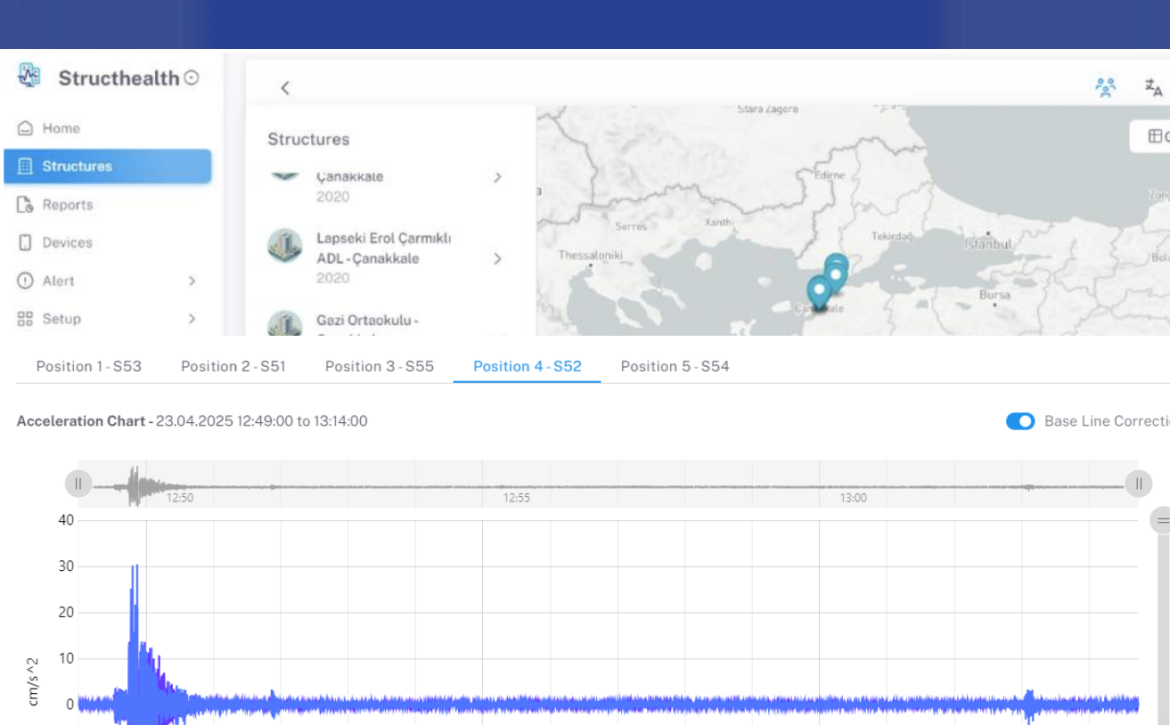
- Using highly sensitive accelerometers, we measure the structure’s natural frequencies, mode shapes and damping ratios either continuously or at scheduled intervals.
- Significant changes in natural frequencies over time often indicate loss of stiffness due to cracking or weakening of load-bearing elements.
- By comparing the building’s dynamic properties before and after earthquakes – or over several years – we can distinguish between normal ageing and damage that requires intervention.
The StructHealth platform automatically processes these modal parameters and presents them as clear, engineer-friendly dashboards and reports.
3.2. Monitoring soil–structure interaction
- Sensors and/or tilt meters at different corners of the building allow us to track:
- long-term settlements,
- tilt (rotation),
- and differential movements across the footprint.
- This is especially important near metro lines, deep excavations, reclaimed land or areas with changing groundwater conditions.
- With SHM, the effect of construction activities in the vicinity on nearby buildings is quantified with real data, not assumptions.
StructHealth visualises these measurements on maps and floor plans, highlighting areas of concern for engineers and decision-makers.
3.3. Threshold-based automatic alerts
- For each structure, we can define limits for acceleration, tilt, frequency change, crack width or other key parameters.
- When these thresholds are exceeded,
- site managers,
- facility operators,
- or municipal authorities
receive SMS, e-mail or platform notifications.
This gives stakeholders the chance to act in time – to organise preventive evacuation, detailed inspection or strengthening – instead of reacting after a collapse.
3.4. Rapid post-earthquake condition assessment
- After an earthquake, SHM records the maximum accelerations, displacements and spectral demands actually experienced by the structure.
- These measurements are compared against a pre-defined numerical model / digital twin of the building.
- This helps determine whether the building has been subjected to demands beyond its expected performance level.
For municipalities and large facility owners responsible for dozens or hundreds of buildings, StructHealth supports data-driven prioritisation: which buildings must be checked first, and where to allocate limited engineering resources.
4. Who benefits the most?
SHM and early-warning solutions bring significant value to several key stakeholders:
- Municipalities and public authorities
- Mapping the risk level of the existing building stock,
- Identifying priority zones for retrofitting or redevelopment,
- Monitoring the impact of metro, tunnel and deep excavation projects on surrounding structures.
- Residential building and site managers
- Understanding how their building actually behaves under real loads,
- Supporting periodic engineering inspections with instrumented data.
- Industrial facilities and organised industrial zones
- Monitoring stacks, silos, tanks and critical production lines,
- Evaluating structural safety and business continuity after earthquakes.
- Education and healthcare buildings
- Tracking performance in schools and hospitals where life safety is paramount,
- Accelerating decision-making about usability after seismic events.
5. What does the Gebze incident tell us?
The building collapse in Gebze is not a random outlier. It shows how:
- soil conditions,
- structural design and detailing,
- changes in usage over time,
- lack of maintenance and inspection
can combine into a slow-moving but deadly risk, even when there is no major earthquake.
Three key messages emerge:
- One-time checks at the design and permit stage are not enough.
Structures need to be assessed and monitored repeatedly throughout their entire service life. - Soil–structure interaction is dynamic.
Every new excavation, tunnel, fill or change in groundwater can alter the way a building behaves. - Data-driven decision-making is no longer optional.
In critical zones, structural health monitoring has moved from “nice to have” to “essential infrastructure”.
Conclusion: Learning from tragedy – and not repeating it
We extend our deepest condolences to the families affected by the collapse in Gebze.
Instead of treating such disasters purely as matters of fate, we must turn:
- soil investigations,
- periodic assessments,
- sensor-based Structural Health Monitoring systems,
- digital twins and advanced data analytics
into standard practice in our cities.
Whether it is a single apartment block, an industrial plant, a school or a hospital:
If we cannot answer the question “How does this building really behave?”, we cannot be sure about its safety.
Would you like to evaluate your building with StructHealth? (CTA section)
Share a few details about your building or project. Our team will contact you with Structural Health Monitoring and risk assessment options tailored to your needs.